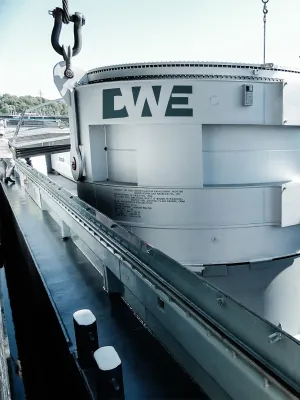
Molten-Salt Reactors
Multi-tubular fixed-bed reactors for heterogeneously catalyzed gas-phase reactions using molten heat-transfer salts for precise temperature control — the reference technology for the highest selectivity and yield in chemical processes above 250-300 °C operating temperature.
Molten-salt reactors form the core of the DWE portfolio. By using molten heat-transfer salts on the shell side, chemical reactions can be operated at temperatures above 250–300 °C with exceptionally precise temperature control. The high heat capacity and excellent heat-transfer of the salt ensure near-isothermal operation even for strongly exothermic reactions and reactors with several tens of thousands of tubes.
The result is higher selectivity, maximum product yield, long catalyst service life, and safe, robust plant operation. In addition to exothermic applications, the technology is also suitable for endothermic processes up to approximately 600 °C. Molten heat-transfer salts enable a large heat input capacity in the range of several tens of megawatts while offering an exceptionally wide operating-temperature range. This makes it possible to realize both multi-zone reactors with different temperature levels and temperature swings from below 300 °C to above 500 °C for the in-situ regeneration of the catalyst.
Molten-salt reactors form the core of the DWE portfolio. By using molten heat-transfer salts on the shell side, chemical reactions can be operated at temperatures above 250–300 °C with exceptionally precise temperature control. The high heat capacity and excellent heat-transfer of the salt ensure near-isothermal operation even for strongly exothermic reactions and reactors with several tens of thousands of tubes.
The result is higher selectivity, maximum product yield, long catalyst service life, and safe, robust plant operation. In addition to exothermic applications, the technology is also suitable for endothermic processes up to approximately 600 °C. Molten heat-transfer salts enable a large heat input capacity in the range of several tens of megawatts while offering an exceptionally wide operating-temperature range. This makes it possible to realize both multi-zone reactors with different temperature levels and temperature swings from below 300 °C to above 500 °C for the in-situ regeneration of the catalyst.
For the established molten-salt processes, DWE is the world’s leading supplier.

Applications (exothermic partial oxidations)
- Phthalic anhydride (PA) and maleic anhydride (MA)
- Acrylic acid (AA) and acrolein
- Methyl methacrylate (MMA)
Reactor characteristics
Multi-tubular reactors with up to 60,000 tubes, single- and multi-stage
Manufacturing advantage
As reactor size and tube number increase, the demands on manufacturing quality and temperature control grow disproportionately. It is precisely in this boundary region that DWE’s experience lies — demonstrated, among others, by the world’s largest salt-cooled reactor (Wanhua, 12 m diameter, 73,000 tpa MA).

Outlook — molten-salt reactors for process electrification

Process development,
numbering-up, and life cycle
A key feature of this reactor technology is the direct transferability from pilot scale to the full-scale plant. Together with technology and licensing partners, DWE develops the corresponding IP equipment in its own pilot facilities. The starting point is always a single-tube reactor — already with commercial tube length, commercial tube diameter, and commercial catalyst, including the final particle geometry.
This eliminates the scale-up steps otherwise often required — from short laboratory reactors to multi-meter reaction tubes, or from catalyst powders to commercial shaped catalysts. Even at pilot scale, the flow, heat-transfer, and reaction conditions of the later production reactor are reproduced. Because the single reaction tube is identical to the tube of the later full-scale plant, the transfer to industrial scale is achieved by “numbering-up”.
Capacity is increased through the number of tubes, not through changes to the reaction conditions, the tube geometry, or the catalyst. The behavior of a single tube can thus be transferred with high accuracy to reactors with several tens of thousands of tubes. This approach enables the low-risk and rapid industrialization of new processes. The world-scale MA reactor for Wanhua, for example, was developed directly from the commercial single-tube concept, without an intermediate demonstration reactor. As the original equipment manufacturer, DWE then supports the plants throughout their entire life cycle — from revamps and capacity increases to spare-parts supply, inspection, maintenance, and modernization in OEM quality.
References
Wanhua, China (2023)
World’s largest single-zone salt-cooled reactor: 3 reactor systems, Ø 12 m, up to 450 °C, each with a capacity of 73,000 tpa maleic anhydride.