Technology and Capabilities

Bigger. Heavier. More complex. That’s exactly what we are built for.

Schweißarbeiten an einem Großapparat in der Fertigung von DWE

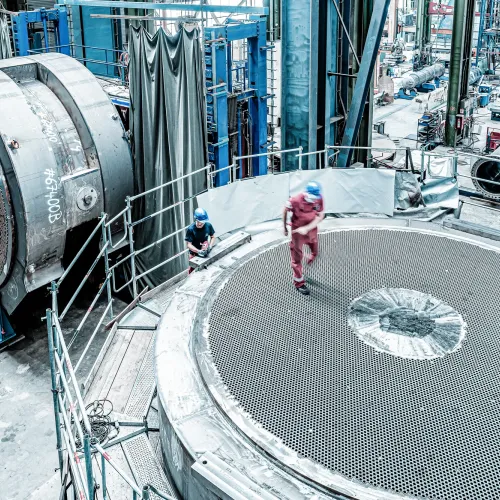
Big challenges call for industrial solutions. At its Deggendorf site, DWE develops and manufactures reactor systems, pressure vessels, and special components in dimensions, weights, and material combinations that only a few manufacturing sites worldwide can master. The combination of engineering, in-house manufacturing depth, large-part machining, and decades of experience enables the economical realization of even the most complex apparatus and plant components.
Manufacturing processes

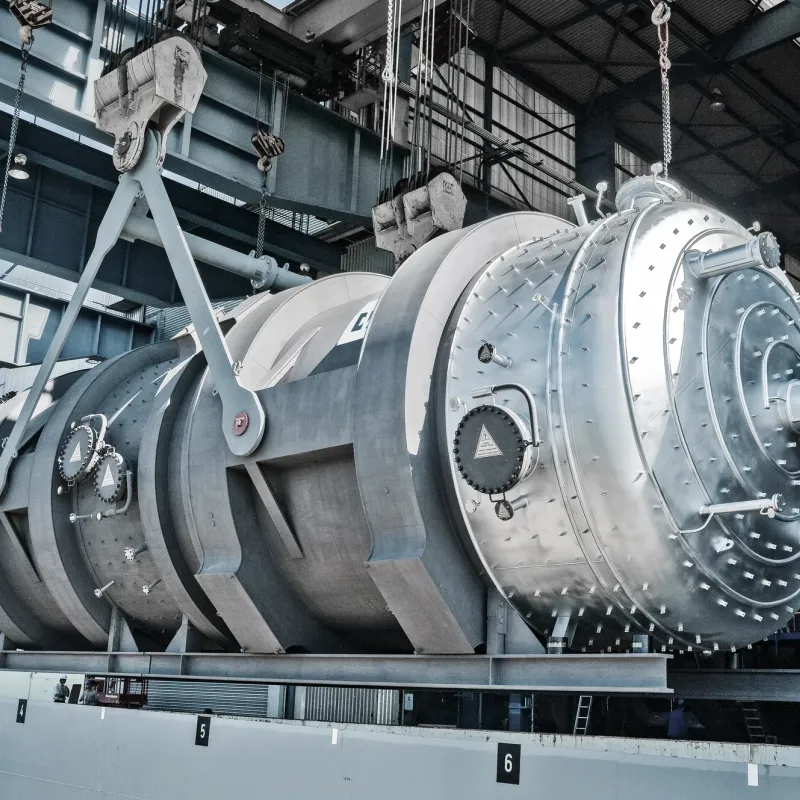
The scope of services covers the entire manufacturing process, from plate working to final assembly. This includes cutting, rolling and special forming, welding, Post Weld Heat Treatment (PWHT), machining, deep-hole drilling, large-scale milling, and surface treatments up to electropolishing. For thick-walled parts, large-format components, and demanding special materials, specially designed manufacturing, lifting, and heattreatment capacities are available. Thanks to the close integration of engineering, manufacturing, and quality assurance, even unusual geometries and the highest technical requirements can be realized reliably.

Großzerspanung eines Reaktorbauteils bei DWE

Sizes and handling

DWE manufactures components up to 12 m in diameter, 80 m in length, and 1,500 t in piece weight. Dimensions like these require not only manufacturing areas and crane capacities on a corresponding scale, but also the experience to handle components of this size dimensionally accurately and without damage across every manufacturing step. This ability to safely master the weight and dimensions of even the largest single components is one of the foundations of DWE’s profile. The site’s integrated logistics options make a key contribution here: with its own Danube port, rail connection, and heavy-load infrastructure, even exceptionally large and heavy components can be transported directly from the manufacturing floor.

In-house manufacturing depth at a single site

From cutting, forming, welding, and machining to heat treatment, testing, and documentation, manufacturing comes together at a single site. This depth keeps control over every manufacturing step in-house — from the delivery of the material to the finished, tested component — and avoids the interfaces at which quality and schedules are otherwise lost. Manufacturing is complemented by extensive large-scale machining capacities, deep-hole drilling technology, and heat-treatment facilities for demanding pressure equipment and special materials.

Luftaufnahme des DWE-Werksgeländes an der Donau in Deggendorf

Welding technology and materials

Welding is one of the central manufacturing disciplines at DWE. All essential welding processes are performed in-house and backed by several hundred active welding procedure qualifications to the AD code as well as Welding Procedure Specifications (WPS) to ASME. The combination of comprehensive materials expertise, decades of manufacturing experience, and high-performance manufacturing facilities enables the production of demanding apparatus and reactors for the chemical and process industries.

TIG, SAW, SMAW, MAG, and orbital welding

Plasma and flame cutting, as well as carbon-arc gouging

Processing of carbon steels, low-alloy steels, austenitic and ferritic stainless steels, duplex steels, nickel-based alloys, titanium, zirconium, and magnesium
Several hundred active welding procedure qualifications to the AD code and WPS to ASME
To reduce residual stresses and meet material- and code-related requirements, DWE performs post-weld heat treatment (PWHT) in its own furnace. The facility offers a working space of 7 m × 7 m × 14 m at temperatures up to 800 °C and enables the treatment of large-format apparatus and reactor components. For larger components, mobile heat-treatment systems are used.
Multi-tubular reactors and heat exchangers with up to 120,000 tube-to-tubesheet welds per reactor
Narrow-gap welding of thick-walled components up to 400 mm wall thickness

Large-scale and mechanical machining

The machining of large components is carried out on machines specifically designed for apparatus and reactor construction. Large gantry milling machines, deep-hole drilling systems, and multi-spindle boring mills enable the precise machining of large-format parts with high demands on dimensional and positional accuracy.

Separate stainless-steel production

A dedicated, physically separated production hall is available for stainless steels and special materials. This separation prevents iron contamination and is a prerequisite for components with the highest demands on cleanliness, vacuum tightness, and magnetic properties. This applies in particular to applications in chemicals, vacuum technology, research, and the nuclear and fusion sectors.

Testing and verification

Quality assurance is an integral part of manufacturing. Non-destructive examination (NDE) comprises ultrasonic testing (UT), radiographic testing (RT), TOFD, phased array, magnetic-particle and dye-penetrant testing, and helium leak testing. This is complemented by hydraulic pressure tests, vacuum-tightness tests, magneticpermeability measurements, and state-of-the-art 3D metrology, including laser-tracker systems for large-dimension components. Manufacturing is carried out in accordance with the relevant international codes and customer specifications, including ASME, AD 2000, PED, and EN 13445.

Design and manufacturing planning

Manufacturing planning begins long before the first weld. Already during design, DWE takes into account material availability, manufacturing-oriented design, welding and heat-treatment concepts, thermal and mechanical loads, residual stresses, and CFDbased analyses. This is complemented by the planning of fabrication sequences, inspection accessibility, NDE concepts, assembly procedures, and schedule and cost structures. This expertise ensures that even large and complex apparatus not only function structurally, but can also be manufactured efficiently, tested completely, and delivered on schedule.

Showcase

One example of the required manufacturing level is the plasma vessel of the Wendelstein 7-X fusion experiment: a complex-shaped, double-walled, vacuum-tight welded construction with tight limits on magnetic permeability and surface quality.